
Introduction
Leadership is not only about holding a title. At its best, it is about using responsibility to leave the world better than we found it. In this conversation, the discussion explores the evolution of purpose, values and leadership through a deeply human lens. The speaker reflects on being fortunate in their journey, but also shaped by values formed early in life: to care, to serve and to help improve the community. From leadership roles at Vinnies to Telethon Speech and Hearing, the conversation highlights the privilege of being a voice for those who may not have power, supporting families, caring for children and helping organisations find their way. It also raises a clear challenge: while services may work at a personal level, the wider systems remain fractured.
What Does Purpose-Led Leadership Really Mean?
Purpose-led leadership means understanding that leadership is not just about position, performance or status. It is about service.
In the conversation, the speaker reflects on their journey and says they feel extraordinarily fortunate. But that fortune is not described only in terms of career opportunity. It is connected to a deeper sense of purpose: the belief that we are here to leave the world better than we found it.
That idea sits at the heart of purpose-led leadership. It asks leaders to think beyond themselves and focus on the people, families and communities they are there to support.
For the speaker, leadership has included being a voice for someone who may not have the power to speak, caring for someone in a difficult moment, or helping look after someone else’s child. These are not small responsibilities. They are privileges that carry deep trust.
Watch the complete Podcast
How Do Values Shape a Leadership Journey?
Values shape leadership by guiding decisions, behaviour and the way leaders see their role in the world.
The speaker reflects that certain values were honed from childhood. This early understanding helped shape the belief that their place in the world was to try to make it better. That is a powerful foundation for leadership because it creates consistency. When the pressure rises, values help leaders remember why the work matters.
Values also influence how leaders treat people. In this conversation, the speaker talks about care, humility, service and responsibility. These values are visible in the way they describe leadership roles across different sectors.
Good leadership is not only about strategy. It is also about character. It asks whether a leader can stay grounded, listen well, act without ego and understand where they can truly add value.
A values-led leader does not simply ask, “What can we do?” They ask, “What is the right way to do it?”
Why Is Humility Important in Leadership?
Humility matters because leaders are often working within complex systems where no one organisation can solve every problem alone.
The speaker describes leadership as humbling and something they treasure deeply. This matters because the work discussed in the conversation involves vulnerable people, families, children, disability, housing, health and community needs. These are not areas where ego helps.
Humility allows a leader to recognise both strength and limitation. The speaker asks an important question: how do we do this without ego? That question is central to meaningful leadership.
Organisations should not try to be all things to all people. Instead, they should understand where they add value and where others may be better placed to lead.
Humility helps build trust. It allows partnerships to form. It helps leaders listen before acting. Most importantly, it keeps the focus on the people being served, not on the organisation’s image.
What Did Leadership at Vinnies Teach About Community Need?
The speaker refers to their first foray as a CEO at Vinnies, describing it as a wonderful organisation with an important footprint.
From the conversation, Vinnies appears to have shaped part of the speaker’s understanding of housing, care and community need. The experience helped build awareness of how people can fall through gaps and how organisations can respond when people need support.
Leadership in such a setting is not only about managing services. It is about seeing people clearly. It is about understanding hardship, vulnerability and the practical support people need in moments of pressure.
The speaker’s reflection suggests that this experience became part of a wider leadership journey. It helped inform later thinking about how housing, health, disability and therapy services can connect.
The lesson is clear: real leadership grows when experience is carried forward and used to strengthen future work.
How Did Telethon Speech and Hearing Shape the Speaker’s Leadership?
The move into Telethon Speech and Hearing, also referred to as TSH, gave the speaker another opportunity to support an organisation providing valuable services to families.
In the conversation, the speaker says the organisation needed assistance to get back on track, while also recognising that the services it provided were fantastic for families. That is an important distinction. Sometimes an organisation may need support structurally, while the work being done on the ground remains deeply valuable.
This kind of leadership requires care. It is not about dismissing what came before. It is about seeing what is strong, understanding what needs attention and helping the organisation move forward.
The experience also added to the speaker’s understanding of therapy, children, disability and family support. It helped build a wider view of how services connect and where community needs may be growing.
Leadership, in this sense, becomes a process of learning across sectors.
Why Do Community Services Need to Work Together?
Community services need to work together because people’s lives do not fit neatly into one category.
The conversation brings together housing, disability, therapy, health and family support. These areas often overlap in real life. A child may need therapy support. A family may also face housing stress. A person may need care, advocacy and practical assistance at the same time.
The speaker reflects on bringing different histories and experiences together within a group setting and asking, “We’ve got these skills. We can see the needs in the community. How do we use our skills really well?”
That question is at the heart of better service design.
When services work in isolation, people can be forced to navigate systems that do not speak to each other. When organisations collaborate well, support can become more practical, more human and more effective.
The goal should be to meet people where their needs actually are.
What Does It Mean to Be a Partner People Want to Work With?
Being a partner people want to work with means bringing value without ego, clarity without control and support without trying to dominate every space.
The speaker asks how organisations can become the partner others want to work with. This is an important leadership question. Partnerships are not built only through reputation or resources. They are built through trust.
A good partner understands where they add value and where they do not. They do not try to be everything to everyone. They know their strengths, respect the strengths of others and focus on shared outcomes.
This kind of partnership is especially important in community services, where problems are often complex and deeply human. No single organisation can fix everything.
Strong partnerships allow people and organisations to combine skills, share insight and create better solutions for the community.
Why Do Leaders Need to Think Differently About Solutions?
Leaders need to think differently because existing systems have not fully solved the problems they were designed to address.
The speaker puts it plainly: if everything worked before, they would not be in the business they are in. That does not mean nothing works. The speaker acknowledges that services do make a difference at a micro level. People benefit every day from the work being done.
But the broader systems are described as fractured at best. This is a careful but honest observation. It suggests that while individual services may help, the wider structures around housing, health, disability and care may still fail to connect properly.
Thinking differently means asking deeper questions. Why are people still falling through gaps? Why are services not joining up? Where do systems create pressure rather than relief?
Better solutions begin when leaders are honest about what is not working.
Are the Systems Broken or Fractured?
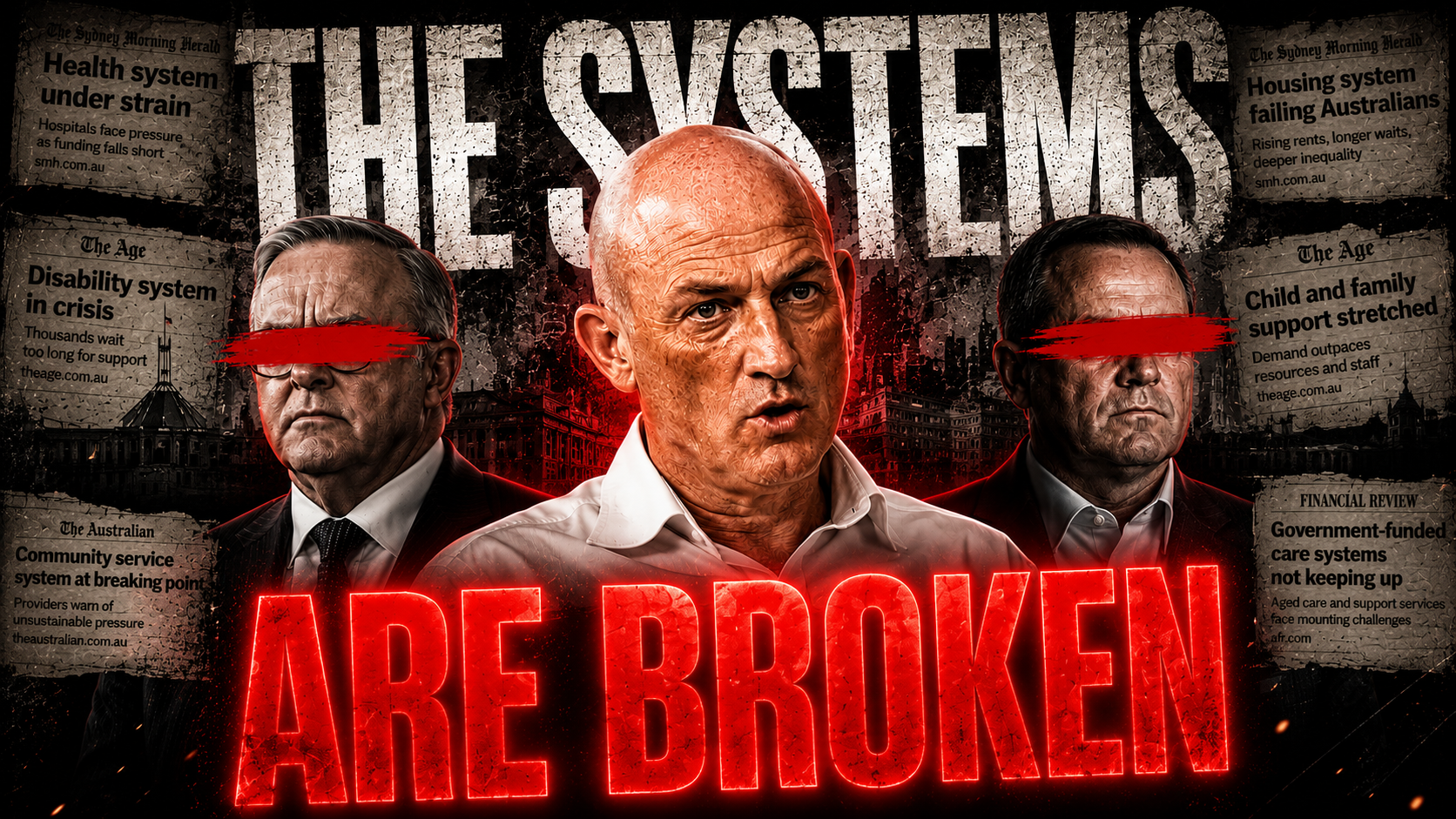
In the conversation, the speaker begins to say the systems are broken, then softens the statement and describes them as fractured at best.
That phrase matters. It captures the reality that many systems still provide real help, but often not in a way that is connected, consistent or easy for people to navigate.
At a personal level, workers and organisations may be doing excellent work. Families and individuals may experience genuine support. But at a system level, gaps remain. Services may be disconnected. Needs may be complex. People may be forced to repeat their story or search for help across multiple agencies.
Calling systems fractured is not about blaming one person or one organisation. It is about recognising that the structure itself needs attention.
If the system is fractured, leadership must focus not only on service delivery, but on connection, reform and better ways of working together.
Final Thoughts
This conversation is a thoughtful reflection on purpose, values and leadership. It reminds us that leadership is not only about career trajectory. It is about how a person’s values evolve, how they carry responsibility and how they use their position to serve others.
From Vinnies to Telethon Speech and Hearing, the speaker’s journey shows the importance of humility, partnership and a clear sense of purpose. It also challenges us to look honestly at systems that may help at a micro level but remain fractured at a broader level.
Better communities require better systems, but better systems also require leaders who can think differently, work without ego and keep people at the centre.
Join us for a moving and inspiring conversation at the National AI & Cybersecurity Leadership Summit 2026 on 19th June 2026. The summit will bring together leaders, innovators, policymakers and changemakers to explore leadership, technology, safety, trust and the future of society.
I would love to hear your insights. What does purpose-led leadership mean to you, and how can leaders help repair fractured systems?