Why the Care Economy Needs Everyone at the Table
Topics Discovered: care economy, disability services, aged care, early childhood, mental health, youth services, domestic violence support, healthcare, governance, red tape, state and federal funding, service providers, peak bodies.
Introduction
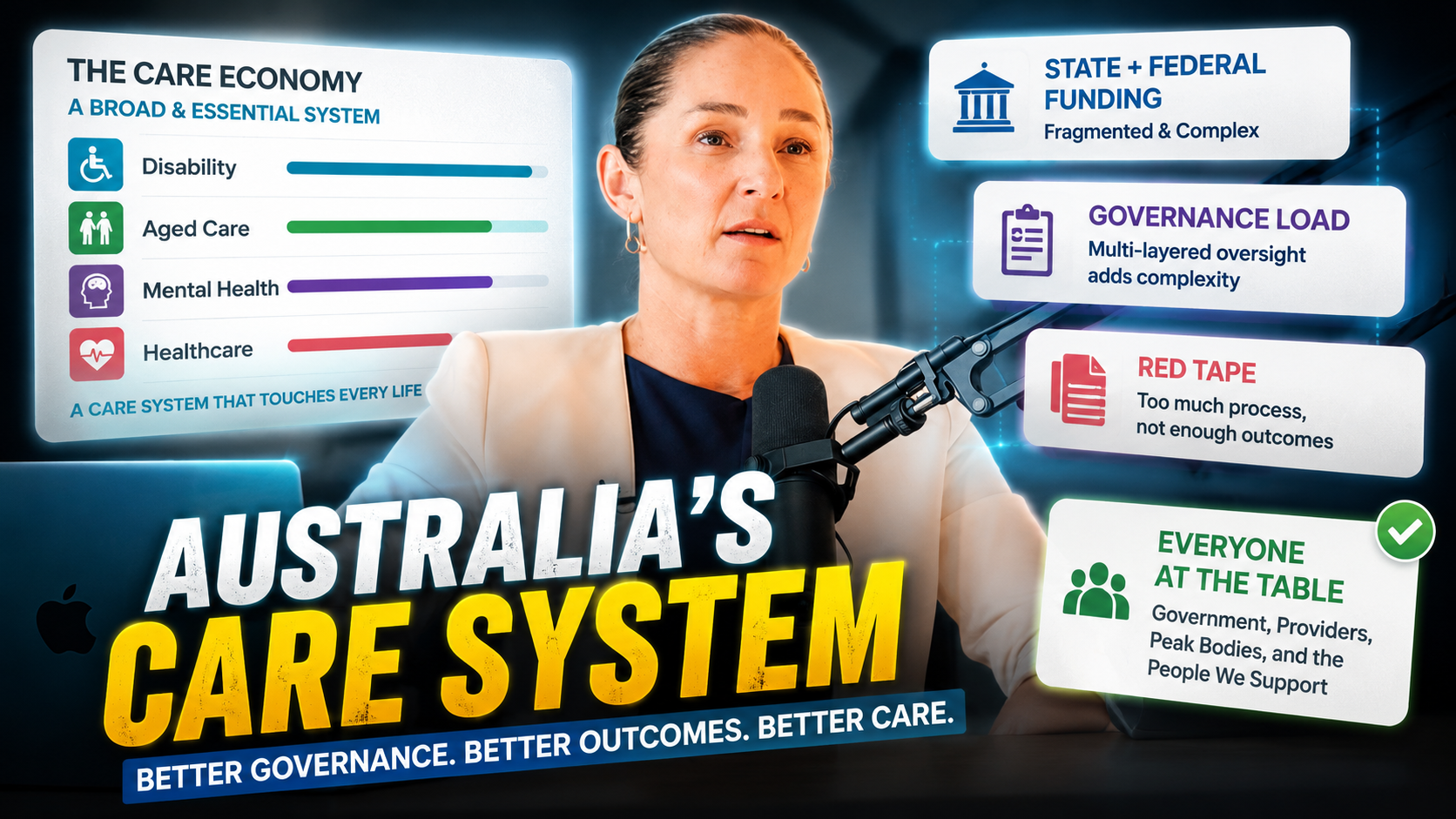
The care economy touches almost every part of community life. It includes disability support, aged care, early childhood services, mental health, youth support, domestic violence services and healthcare. Yet the way these services are funded and governed can often feel fragmented. Some responsibilities sit with state governments, while others sit with the federal government. For organisations delivering services across multiple areas, this can create layers of governance, reporting and red tape that take energy away from the people they are trying to support. In this conversation, the speaker argues that genuine reform requires everyone at the table: all levels of government, peak bodies, providers and, most importantly, the people receiving support.
What Is the Care Economy?
The care economy refers to the broad range of services that support people’s health, wellbeing, safety and participation in community life.
In the conversation, the care economy is described as very spread out. It covers disability, aged care, early childhood, mental health, youth services, domestic violence support and healthcare. These are not separate issues in real life. Many people and families may interact with more than one part of the system at the same time.
For example, a family may need early childhood support, disability services and mental health care. An older person may need aged care and healthcare. A person escaping domestic violence may need housing, counselling, legal support and safety planning.
This is why the care economy matters so deeply. It is not just a sector. It is the network of services that helps people live with dignity, safety and support.
Why Is Governance So Complex in the Care Economy?
Governance is complex because different parts of the care economy are funded and managed by different levels of government.
The transcript highlights that some services are funded by the state and others by the federal government. This creates a layered system for organisations that deliver multi-tier services. They may have to report to different departments, follow different rules and manage different compliance requirements.
Good governance is important. People receiving care need to be protected, supported and treated properly. There must be oversight to ensure services are safe and effective.
But the concern raised in the conversation is that too much red tape may not always lead to better outcomes. Instead, it can add pressure to providers who are already trying to meet complex community needs.
The challenge is finding a better balance between accountability and practical service delivery.
Watch the complete Podcast
How Does Multi-Layered Funding Affect Service Providers?
Multi-layered funding can make service delivery more difficult because organisations may have to move between different funding systems, rules and reporting structures.
In the conversation, the host points out that the governance load on organisations builds up when they provide services across both state and federal systems. Each funding stream may come with its own expectations, audits, reporting deadlines and compliance requirements.
This can create real pressure for providers. Instead of focusing fully on people and outcomes, organisations may spend significant time managing administration.
That does not mean oversight should disappear. The speaker makes it clear that good governance and care standards are still needed. But there is a question about whether the current level of complexity is helping or holding back better care.
For providers, simpler and clearer governance could make it easier to focus on what matters most: supporting people well.
Why Do All Levels of Government Need to Be Involved?
All levels of government need to be involved because the care economy crosses state and federal responsibilities.
The speaker says clearly that everyone needs to be at the table. That includes all levels of government. This is important because no single level of government controls every part of the care economy.
Disability, aged care, healthcare, mental health, domestic violence support, early childhood and youth services can all involve different policy settings and funding responsibilities. If governments work separately, service users and providers may be left navigating gaps and duplication.
Bringing all levels of government together allows the sector to ask better questions. Who is responsible for what? Where is the overlap? Where are people falling through gaps? How can funding and governance be better aligned?
A more joined-up approach could reduce confusion and improve outcomes across the whole care system.
Why Should Peak Bodies and Providers Be at the Table?
Peak bodies and providers should be at the table because they understand the realities of service delivery.
Governments may set policy and funding rules, but providers are often the ones working directly with people every day. They see where systems work, where they fail and where unnecessary complexity creates pressure.
Peak bodies also play an important role because they can represent wider sector experience. They can bring together patterns, evidence and concerns from multiple organisations.
The speaker’s point is practical. If reform is discussed only at government level, it may miss what is actually happening on the ground. Providers and peak bodies can help ensure that policy decisions are grounded in real service experience.
Meaningful reform requires the voices of those who design, fund, deliver and receive care. Without that mix, solutions may remain disconnected from reality.
Why Must the People Receiving Support Be Included?
The people receiving support must be included because they are the ones most affected by the system.
In the conversation, the speaker says that providers and peak bodies need to be included, as well as the people being supported. This is essential. A care system should not be designed only around funding structures or organisational convenience. It should be designed around people’s lives.
People with lived experience can explain what it feels like to move through the system. They can identify gaps that professionals may not see. They can show where services are confusing, where support is missing and where dignity is being protected or lost.
If the goal is better outcomes, then the voices of service users must be central. They are not just recipients of care. They are experts in their own experience.
A better care economy begins by listening to the people it exists to support.
How Can the Sector Move Towards Better Governance?
The sector can move towards better governance by bringing all key voices together and focusing on outcomes rather than only compliance.
The conversation raises the idea of evolving beyond multi-layered governance towards a more coherent approach. The speaker does not suggest removing oversight. Instead, they questions whether the current level of governance and red tape is always producing the best outcomes.
A better approach would begin with asking what outcome the system is trying to achieve. Are people being well cared for? Are their needs being met? Are services accessible, safe and effective?
From there, governments, peak bodies, providers and people receiving support could examine which responsibilities sit where and how the system can be simplified.
Good governance should protect people, not overwhelm the organisations trying to support them. Reform should make accountability clearer, not more confusing.
Why Should Outcomes Come Before Red Tape?
Outcomes should come before red tape because the purpose of the care economy is to improve people’s lives.
In the conversation, the speaker acknowledges the importance of governance and oversight. People must be well cared for, and their needs must be met. But the speaker also questions whether heavy governance always produces the best results.
This is a critical point. A system can be highly compliant and still fail to deliver the human outcomes people need. Paperwork can prove that a process happened, but it does not always prove that a person felt safe, respected or supported.
Outcome-focused governance asks whether the system is making a real difference. It still values accountability, but it does not confuse administration with impact.
The care economy exists for people. That means governance should be measured by how well it supports dignity, safety and practical care.
Final Thoughts
This conversation reminds us that the care economy is too important to remain fragmented. Disability services, aged care, early childhood, mental health, youth support, domestic violence services and healthcare all touch real lives. When governance becomes too complex, the people who suffer most are often those who already need support.
Better reform requires everyone at the table: state and federal government, peak bodies, providers and the people receiving care. Good governance should remain, but it must be clear, practical and focused on outcomes.
Join us for a moving and inspiring conversation at the National AI & Cybersecurity Leadership Summit 2026 on 19th June 2026. The summit will bring together leaders, policymakers, innovators and changemakers to explore technology, leadership, governance, trust, safety and the future of human-centred systems.
I would love to hear your insights. How can Australia build a care economy that reduces red tape while improving dignity, safety and real outcomes for people?