
Indian Soldiers in the Great War: Why Their Stories Still Matter
Introduction
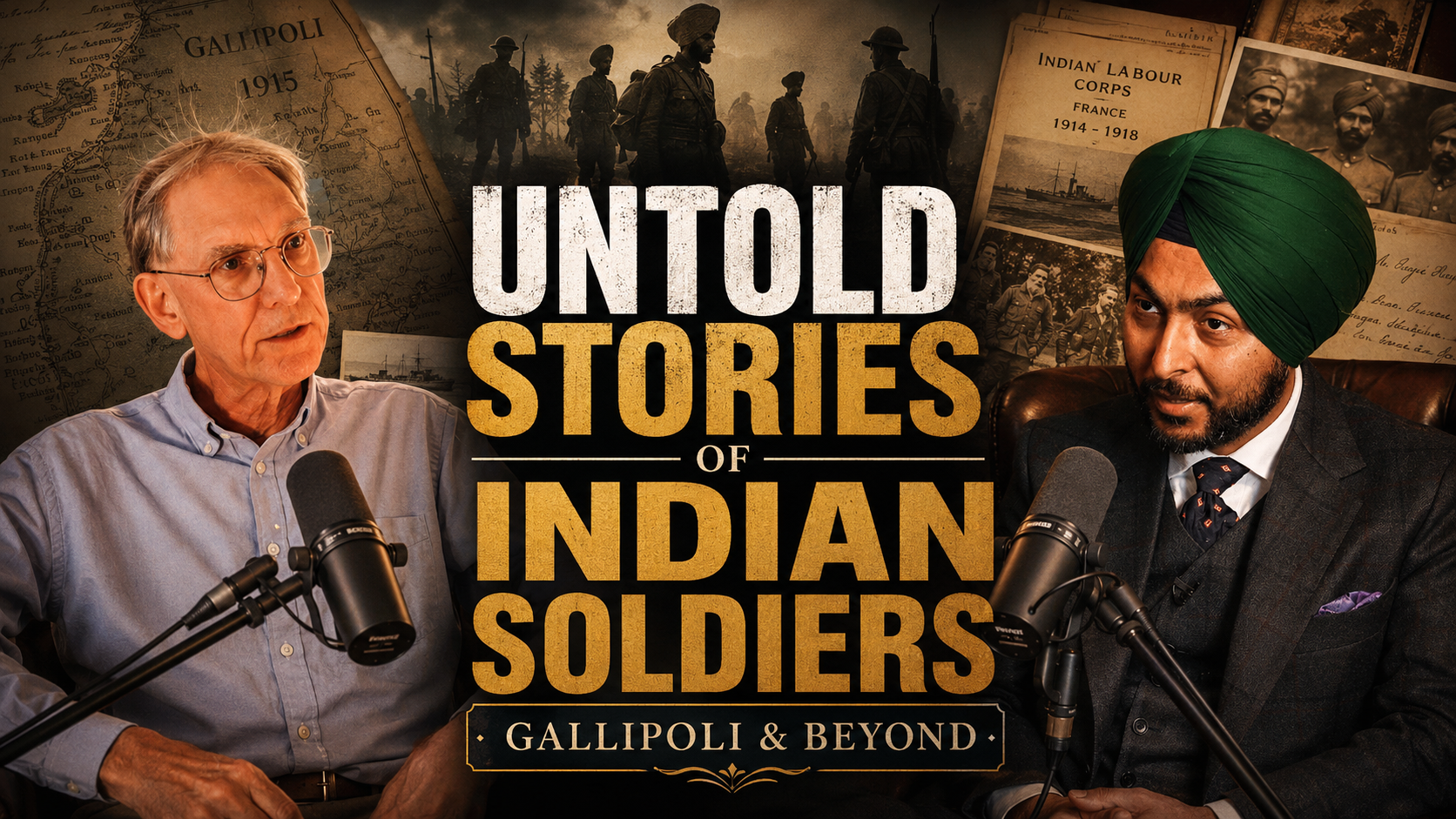
The story of Indian soldiers in the Great War is one of courage, sacrifice, loss and memory. During the First World War, thousands of Indian soldiers served across distant battlefields, including Gallipoli, the Western Front, Mesopotamia and East Africa. Yet, more than a century later, many of their personal stories remain hidden, scattered or completely lost.
In a thoughtful conversation, the discussion turned to an important question: will the history of Indian soldiers in the Great War be preserved through large collective projects, or will it continue to grow through independent research, family discoveries and individual books?
The answer is both practical and deeply human. History often grows like mushrooms: individual projects appear from different places, driven by family memory, academic interest, community effort and personal commitment.
The Growing Interest in Indian Soldiers of the First World War
In recent years, there has been a growing desire to recover the forgotten stories of Indian soldiers in World War One. Families, historians, researchers and community groups are beginning to ask important questions:
Who were these soldiers?
Where did they serve?
What did they experience?
What happened to their families after the war?
Why are so many of their personal stories missing from mainstream history?
This interest is not just academic. For many families across India, Pakistan, Bangladesh and the wider diaspora, it is about identity, memory and belonging. It is about finding the names, faces and voices of ancestors who served in wars far from home.
Why Independent Research Matters
History does not always move through one large official project. Often, it develops through many smaller efforts. A family member may begin by searching for a grandfather’s service record. An academic may examine military archives. A community historian may collect oral stories. A writer may turn forgotten records into a book.
This “mushroom model” of history is especially important when it comes to Indian military history. Different researchers bring different strengths. Some have personal family connections. Others have professional training. Some understand local languages, customs and communities. Others have access to archives in Britain, India, Australia or New Zealand.
Together, these independent projects can create a fuller and richer understanding of the Indian experience in the Great War.
Watch the complete Podcast on YouTube.
The Challenge of Sources
One of the biggest difficulties in researching Indian soldiers in the Great War is the lack of personal sources. Official military records may exist, but personal letters, diaries, memoirs and first-hand accounts are much harder to find.
Many Indian soldiers came from rural backgrounds and were often illiterate, even in their own languages. This meant that fewer personal written accounts were created in the first place. Those that did exist were often scattered, lost, damaged or never preserved by institutions.
The upheaval of 1947 also had a major impact. Partition disrupted families, communities and archives across the Indian subcontinent. In many cases, records were lost, homes were abandoned and family histories were broken apart.
This is why personal sources are so rare and valuable. A single letter, diary or oral memory can change the way we understand a soldier’s life.
Archives Are Scattered Across the World
Another major challenge is that the sources for Indian soldiers are not held in one place. They are spread across several countries, including Britain, India, Australia and New Zealand.
For anyone trying to research Indians at Gallipoli or Indian soldiers in the world wars more broadly, this creates a practical problem. Serious research often requires travel. Travel requires money. And money is not always available.
Funding becomes one of the biggest barriers to doing this work properly. Without financial support, many important projects remain incomplete. Researchers may know where the sources are, but they may not be able to access them.
This is why grants, institutional support, community funding and public interest are so important. Preserving history is not only about passion. It also requires resources.
The Role of Families and Communities
While academics and professional historians have an important role to play, families and communities are just as vital. In many cases, the missing pieces of Indian military history may still be held in private homes, family memories, old photographs, medals, letters or stories passed down through generations.
A family may not realise the historical value of an old trunk, a fading photograph or a name written on the back of a document. Yet these small details can help researchers rebuild lost histories.
Deep community engagement is essential. Some personal sources can only be found when researchers build trust with families and local communities. This is not work that can be done quickly. It requires patience, respect and cultural understanding.
Why These Stories Were Forgotten
The stories of Indian soldiers in the First World War were not forgotten because they were unimportant. They were forgotten because of empire, inequality, language barriers, poor preservation, political change and historical neglect.
Indian soldiers fought for an empire that did not always recognise them equally. Their service was often recorded through official military language, not through their own voices. After the war, their stories were overshadowed by larger political movements, including the struggle for independence and later the trauma of Partition.
As a result, many Indian soldiers became names in records rather than fully remembered human beings.
Recovering their stories is an act of historical justice.
The Future of Research on Indian Soldiers in the Great War
The future of this field will likely be shaped by two key factors: sources and funding.
Where new sources are found, new stories will emerge. Where funding is available, researchers will be able to travel, digitise archives, interview families and publish books. Where communities become involved, forgotten histories may finally come to light.
We may not see one single grand project that captures every story. Instead, we are more likely to see many independent efforts: books, documentaries, podcasts, family histories, academic papers, digital archives and community exhibitions.
That is not a weakness. It may be the most natural and powerful way for this history to grow.
Why This History Matters Today
Remembering Indian soldiers in the Great War is not only about the past. It also speaks to the present.
It reminds us that global history is interconnected. It shows how people from villages across the Indian subcontinent became part of major world events. It challenges narrow versions of war history that focus only on European experiences. Most importantly, it restores dignity to those whose sacrifices were too often overlooked.
Every recovered name, every rediscovered letter and every family story helps rebuild a more honest historical record.
Conclusion: Preserving Memory, Inspiring the Future
The history of Indian soldiers in the Great War is still being written. It lives in archives, families, communities and independent research projects across the world. Although the work is difficult, it is also deeply meaningful.
These soldiers deserve to be remembered not as footnotes, but as individuals with courage, families, emotions, fears and hopes. Their stories are part of our shared global history.
As we reflect on the importance of preserving memory, leadership and human resilience, we invite you to attend the National AI & Cybersecurity Leadership Summit 2026 on 19th June 2026.
Join us for a moving and inspiring gathering where leaders, thinkers and changemakers will come together to explore the future of technology, security and responsible leadership. Just as history teaches us the value of courage and remembrance, the future demands vision, responsibility and collective action.