Social Media Ban Under 16 in Australia: What It Means for Families, Platforms and Young People
The debate around a proposed social media ban for under-16s has intensified across Australia. While some critics argue that young people actively seek out harmful content, the evidence suggests something more troubling: it is often pushed to them.
Powerful algorithms prioritise material that drives engagement and unfortunately, that can mean violent, sexualised, extreme or otherwise inappropriate content. Young users are not always searching for it; they are being served it.
With this in mind, the Federal Government’s proposed social media ban is being framed as a protective measure rather than a punitive one. But how will it work, and what will it mean for families across Queensland?
Why Is the Government Introducing a Social Media Ban?
The central argument behind the proposal is developmental.
Neuroscience tells us that adolescent brains are still forming particularly in areas related to impulse control, emotional regulation and long-term decision-making. Young teenagers may lack:
- Fully developed critical thinking skills
- Emotional resilience to cope with harmful content
- The maturity to manage online risk independently
Sixteen has been suggested as a reasonable threshold. At this age, young people begin to assume greater responsibility they can learn to drive, undertake paid work more independently and make more complex decisions.
The intention behind the ban is to provide young people with more time to develop before being exposed to the full force of algorithm-driven platforms.
How Will the Social Media Ban Be Enforced?
This is the question parents ask most often.
The Government has indicated that enforcement responsibility will sit squarely with social media companies not with parents.
That is a significant shift.
Rather than positioning families as the “enforcers”, the burden will fall on large multinational platforms to ensure that anyone under 16 cannot access their services. Substantial financial penalties may apply if they fail to comply.
However, the exact rollout timeline and mechanisms remain unclear. The earliest implementation could be December 2025, although it is likely to occur later.
Different platforms may adopt different approaches.
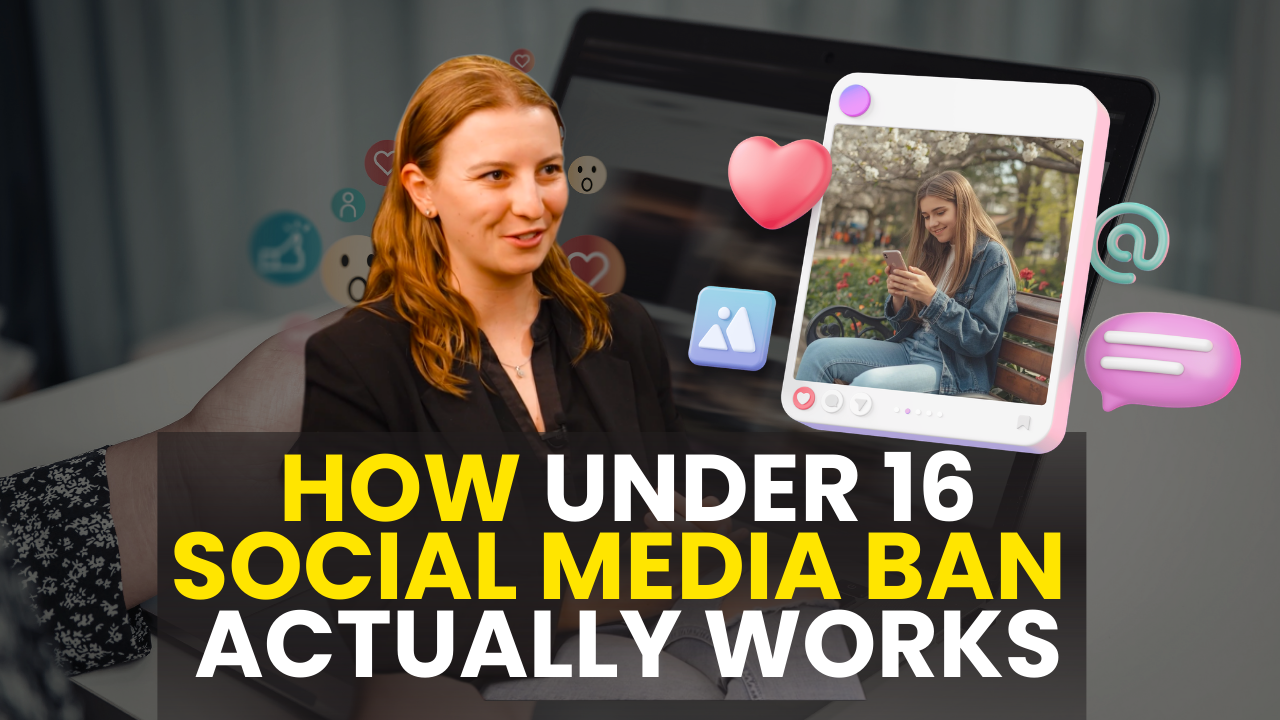
Watch the complete Podcast on YouTube.
Which Platforms Could Be Affected?
Major global platforms operating in Australia would likely be required to comply, including:
- Meta (owner of Facebook and Instagram)
- TikTok
- Snapchat
Each may trial distinct systems for verifying age.
Proposed Age Verification Methods
The Government has suggested two primary pathways:
1. Government ID Upload
Users may be required to upload official identification to prove they are over 16.
If implemented, this would apply universally not just to young people. Adults, grandparents and all existing users could be required to verify their age before accessing their accounts.
This raises legitimate questions around:
- Data privacy
- Cybersecurity risks
- Storage of identification documents
- Trust in multinational tech companies
2. Facial Recognition Technology
A second option involves age estimation technology using facial recognition software.
A government pilot has explored whether artificial intelligence can accurately assess age based on facial features. While technically innovative, this method also raises ethical and privacy concerns, including:
- Biometric data storage
- Consent
- Accuracy rates
- Potential bias in age estimation systems
At this stage, no final model has been confirmed.
What Does This Mean for Parents?
Importantly, the proposal removes formal enforcement responsibility from parents.
Families would still guide and educate their children about online behaviour, but they would not carry legal responsibility for blocking access.
This could reduce household conflict parents would not be positioned as the “villains” denying access. Instead, platforms themselves would implement age restrictions.
However, no technological solution replaces parental engagement. Conversations about digital literacy, critical thinking and emotional resilience remain essential.
The Broader Conversation: Protecting Childhood in a Digital Age
This debate is not merely about technology.
It touches on deeper societal questions:
- How do we protect children in a hyper-connected world?
- Where does corporate responsibility begin and end?
- How do we balance freedom, privacy and protection?
Queensland families, educators and community leaders are rightly engaging in robust discussion. The social media ban proposal reflects a growing global movement to reassess the impact of digital environments on young minds.
Join Us at Our Upcoming Events
Join us at the WA International Women’s Day 2026 – Leaders Breakfast Event. We honour remarkable women. They shaped Western Australia’s history. For instance, they led through activism and caregiving. Moreover, they built communities.
Join Us at the National Child & Family Safety Leadership Summit 2026 will bring together leaders, practitioners, policymakers, researchers and community voices from across the country. This important gathering creates space for meaningful dialogue on the most pressing issues impacting children and families including domestic violence, coercive control, child protection, and community wellbeing.
We look forward to welcoming you to this moving and inspiring celebration of women’s achievements and contributions. Don’t miss this opportunity to hear from one of WA’s most influential scientific leaders, Miquela Riley.