
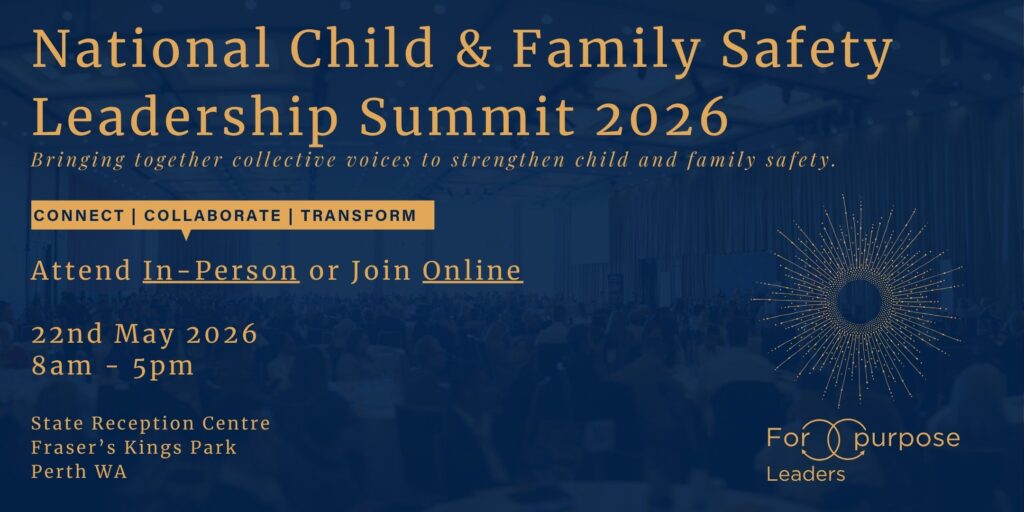









National Child & Family Safety Leadership Summit 2026
Bringing together collective voices to strengthen child and family safety.
For sponsorship and other enquiries please email us at dev@for-purpose.com.au or call us at +61 401 625 001
About the event:
This Summit is part of the For-Purpose Leadership Series
This Summit will bring together leaders, practitioners, policymakers, researchers and community voices from across Australia. This national gathering will provide space for a collective conversation on the pressing issues shaping child and family safety, including domestic violence, coercive control, child protection, and community wellbeing.
Across Australia, critical work is already underway in family and domestic violence services, child protection, community legal services, housing and homelessness, justice, health, education, and First Nations’ community-controlled sectors. The Summit is an opportunity to listen across systems, delve into what is working and what is not, and explore how regulation, quality and safeguarding standards, and workforce capability can support more coordinated and effective responses to keep families safe.
Through six panel conversations, participants will explore the themes of policy and law reform, coercive control, intersectionality, prevention, collaboration and recovery. Together, these discussions will help shape a collective voice and shared understanding of how governments, services, and communities can align efforts to build a safer future for every child and family in Australia.
Why Attend
The National Child and Family Safety Leadership Summit 2026 is more than a conference, it’s a national conversation.
Across Australia, governments, community services and advocates are tackling family and domestic violence, child protection and safety in different ways. This Summit brings those voices together to share experiences, challenges and innovations, and to strengthen collective understanding across systems.
Attending the Summit will give you the opportunity to:
- Connect with leaders and practitioners from across all states and territories working in family and domestic violence, child protection, community legal services, justice, housing, education, and health.
- Learn from national and international experts on policy, prevention, coercive control, recovery, and system collaboration through six high-impact panel discussions.
- Contribute to a shared national dialogue that values inclusion, lived experience, and First Nations leadership in shaping pathways toward safety and wellbeing.
- Explore how emerging technologies, workforce strategies, and safeguarding standards are transforming responses across sectors.
- Collaborate in shaping collective insights that will inform a shared vision for stronger, safer communities across Australia.
Whether you work in policy, service delivery, research, or community leadership, the Summit offers a space to engage in constructive, forward focused conversations that bridge jurisdictions and disciplines — creating connections that continue well beyond the day itself.
Panel Discussions and Topics
The National Child and Family Safety Leadership Summit 2026 will host six national panel conversations bringing together leaders, researchers, policymakers, practitioners and lived-experience voices.
Each discussion explores a critical dimension of Australia’s shared response to family and domestic violence, child safety and wellbeing, highlighting promising practices, key challenges and pathways toward collective action.
These conversations aim not to prescribe reform, but to listen, learn and connect across sectors and jurisdictions, capturing the diversity of experience and insight that strengthens Australia’s approach to safety.
 Panel 1: Children at the Centre: Strengthening Systems of Care and Safeguarding
Guiding Question:
How can Australia’s child, family, health, justice and education systems better connect to respond to the current landscape of family and domestic violence, aligning policy, law reform and safeguarding standards so that every child is visible, heard and safe?
 Panel 2: First Nations Leadership and Governance: Guiding the Way Forward
Guiding Question:
How can Aboriginal and Torres Strait Islander leadership, culture and governance shape responses to family and domestic violence, coercive control and child safety, embedding cultural authority, community control and strong workforce pathways across the system?
 Panel 3: Early Intervention and Perpetrator Accountability: Inclusive Pathways for Safety and Change
Guiding Question:
How can justice, health, community and legal sectors work together to better recognise coercive control, engage perpetrators, and strengthen inclusive pathways for early intervention and lasting change?
 Panel 4: Safe Homes, Health and Economic Security: Building the Conditions for Safety and Recovery
Guiding Question:
How can housing, health and economic systems work together — through shared standards, technology and coordinated policy — to ensure families and individuals can recover, rebuild and thrive after experiences of violence?
 Panel 5: Prevention, Education and Technology: Shaping a Culture of Respect
Guiding Question:
How can education, community, media and workplace sectors, together with lived-experience voices, use prevention programs, respectful-relationships education and technology to drive lasting cultural change and stop violence before it starts?
 Panel 6: One System for Safety: Collaboration, Data and Shared Accountability
Guiding Question:
How can governments, community services, justice, health, child protection and housing sectors collaborate, through shared data, regulation, workforce alignment and restorative pathways to build a more connected, accountable and healing-focused national system?
Who Should Attend
Attendees will include representatives from:
- Federal, state and territory governments: policy, strategy and program areas in FDV, child safety, health, education, justice, housing and social services
- Community and not-for-profit organisations: delivering services in family and domestic violence, child protection, housing, mental health, and family support
- Community legal centres and justice sector professionals: working across family law, criminal law, coercive control, and restorative justice
- Health and education sectors — including early childhood services, schools, and community health networks
- First Nations leaders and community-controlled organisations — guiding cultural governance, healing, and self-determined responses
- Researchers, academics and peak bodies — contributing evidence and innovation to national safety and wellbeing strategies
- Lived-experience advocates and practitioners — bringing invaluable insight to inform systemic change
- Technology, data, and workforce specialists — advancing safety through digital innovation, quality standards, and professional capability frameworks
Join Us in Perth
Whether you join us in Perth, Western Australia or participate online through our live-streamed sessions, you’ll be part of the same national conversation on building safer futures for children and families.
Join us on 22 May 2026 in Perth, Western Australia for a national conversation that brings clarity, confidence, and collaboration to the forefront of leadership.
Please refer to the terms and conditions below:
For sponsorship and other enquiries please email us at dev@for-purpose.com.au.
Southern Aboriginal Corporation (SAC)